
CAMILLA WELLTON · DIARY
By Camilla Wellton
A dress can look exactly right until you sit down. A sleeve can be beautiful with your arms at your sides and become much more interesting when you reach. The mirror gives you one encounter with a garment. Moving gives you several more.
I am interested in that exchange because clothes become part of how we occupy space. They can invite a gesture, make us aware of an outline or require an adjustment. Wearing a garment means discovering a relationship between its shape and the body we bring to it.
My yoga practice began at fifteen and has remained part of my life through teaching, owning a studio and choosing, at thirty, to focus on my fashion brand. Yoga and meditation have shaped all my collections. Attention to the body has continued through the clothes, even as the form of my work has changed.

In the photograph above from The Water, a hand resting in a pocket changes the reading of a pale dress. The gesture gives the eye somewhere to settle. You can imagine the wearer waiting, listening or reaching for something she carries with her.

In the photograph above from The Rise, a turning body makes a flared coat more legible. The lower volume travels away from the legs, while the shaping around the waist holds the composition together. An extended arm and a folded paper bird bring another scale of movement into the photograph.

In the photograph above, The Awakening asks you to follow the generous patterned sleeves.

In the photograph above, The Surreal makes the spaces around the arms especially visible through its rounded openings and sculptural volume. These are different ways of considering the body in relation to the shape around it.
Photographs can draw your attention to those possibilities. Trying a piece gives you the next part of the conversation. Where do you feel freedom? Where do you become conscious of the garment? Do you enjoy that awareness?

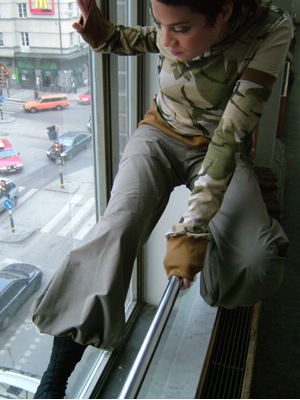
In 2003, my cousin Anna Wellton and I created Chix on Boards. Its street and skate imagery brings the clothes into contact with sitting, crouching and moving through an urban setting. Looking across that collection and the more sculptural work, you can see how different contexts ask different things of a silhouette.
A garment for an evening of conversation has a different practical life from one worn while cycling to work. Even the same dress changes its relationship with you when you exchange a light bag for a heavy one. Your day belongs in the fitting.
Try sitting in the way you actually sit. Reach for something. Walk at your usual pace. Put on the coat or carry the bag you intend to use. These ordinary actions make the choice more specific than asking whether the garment looks good in one position.
Sometimes you enjoy a garment because it changes the gesture you feel like making. A wide hem may invite a turn. A clear shoulder line may make you more aware of your posture. A generous shape may give you a sense of room around yourself.
That experience is personal. What feels expansive to you may feel cumbersome to somebody else. The useful question is whether you enjoy the relationship and want to live with it.
I want the woman wearing my work to have a part in discovering what it becomes. She may be drawn to the drama of a silhouette, the quiet pleasure of a pocket or an unexpected ease in the way the pieces sit together. Each is a way of feeling more at home in her own presence.
When you next try something on, give it a little of your day. The body standing still has offered an introduction. The body moving can tell you more.