
The Rise collection.
I began with clothes, but the work kept opening new doors: from the studio to exhibitions and runway presentations, into film, sound, writing and the things we can make together. Here are some of the moments that changed its shape.
I brought my work into public view at Ung i Stockholm at Kulturhuset. It was one of those early moments when something made privately begins to have a life in other people’s eyes.
I founded my fashion label in Stockholm and put my own name on it. That felt like both a declaration and a promise: whatever I made would have to be something I could stand behind.
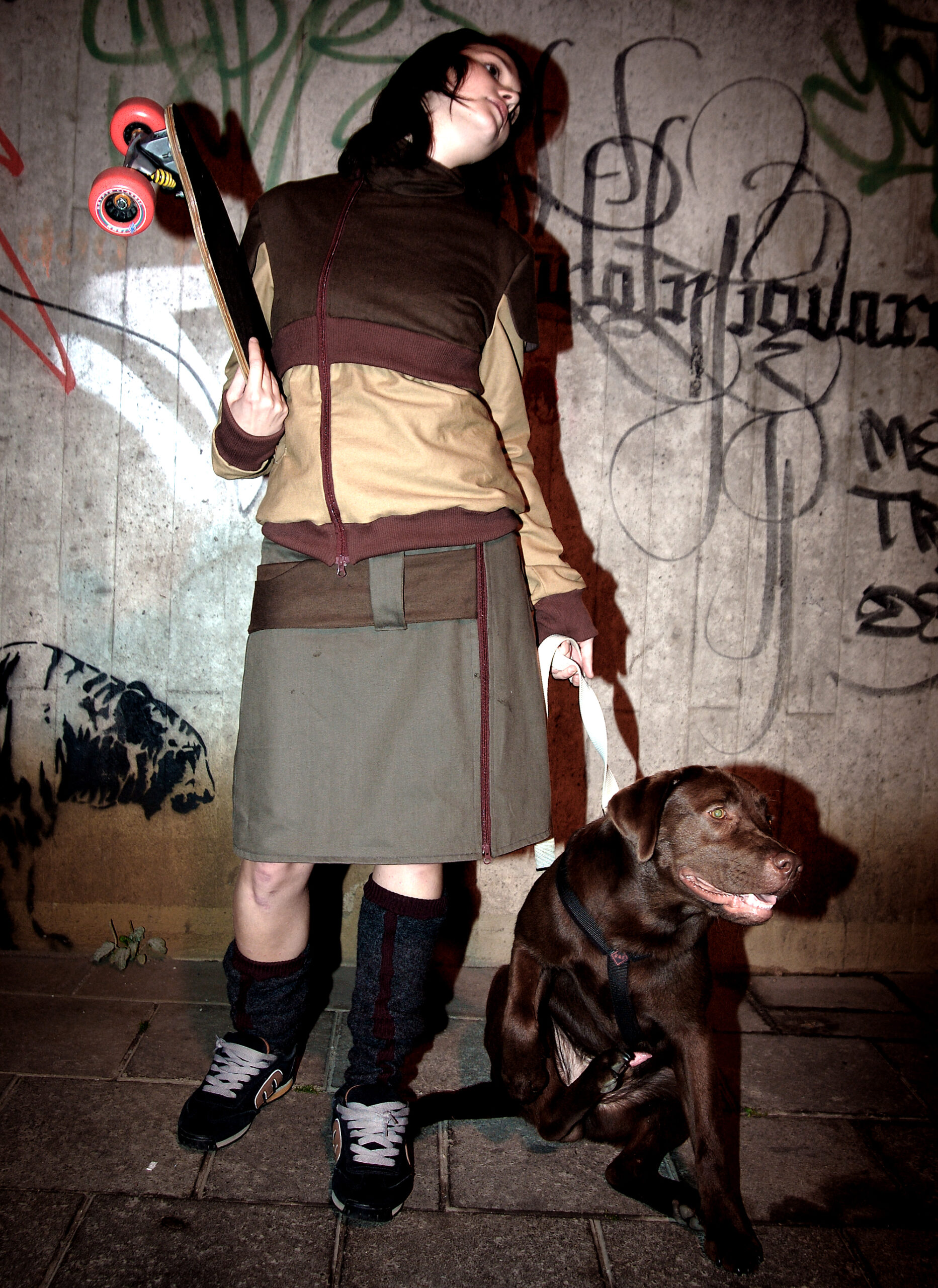
Chix on Boards, created with Anna Wellton in 2003.
Image to the left: Chix on Boards.
Chix on Boards, 2003.
My cousin Anna Wellton and I created Chix on Boards, with hooded shapes, cropped trousers and clothes meant to move among boards, streets and friends. We let the city into the collection.
I presented at Stockholm Fashion Week in Älvsjö and began organising Fashionstreet. Between 2004 and 2006, we brought designers, music and shopping into the same room. I wanted fashion to be encountered, not kept at a distance.
Alongside fashion, I taught slow Hatha yoga in Stockholm, giving classes, courses and workshops. Movement and attention to the body were already part of how I designed. Teaching gave that interest another place to live.
At the Swedish cultural days in St Petersburg, I presented my collection with Art East and helped bring the wider Swedish fashion programme to life. I led the team and choreographed the shows. The clothing was only one part of what we made together.
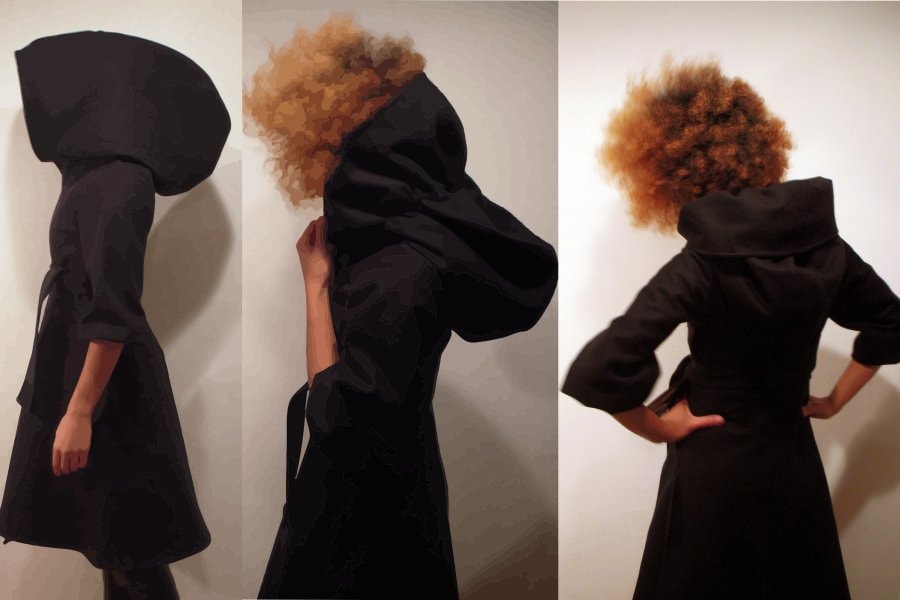
Camilla Wellton’s sculptural coat, published by Dazed in 2008.
Anna Battista interviewed me for Dazed about Dakini, the Kimonoat and the Kimonacket. We talked about the pleasure of cutting patterns, and about making garments in close dialogue with the person who will wear them. I still think of that encounter whenever a sketch becomes a real body of cloth.
The coats and jackets found a new stage at Ateljé Ciresia during Stockholm Fashion Week. I presented them on the runway and in the showroom. Ragtrader also wrote about a planned capsule for Australia. Back in Stockholm, I founded YoginiNation, running the studio while the fashion work continued.
I made a pale, softly structured dress for Sisters Academy, with a hood that rises around the face and a long, flowing line beneath it. I wanted the shape to offer presence without asking the woman inside to perform. It became one of the competition’s winning designs, selected for a limited collection to be produced for Sisters stores.
At IKEA Garderob, my work also received the visitors’ choice recognition in 2010. To watch a private idea encounter people who had never been inside my studio was its own kind of education.
London Fashion Week brought me to Estethica, the British Fashion Council’s showcase for fashion made with ethical and environmental consideration. I was there with my work, and I was shortlisted for the UK Innovation Award. I loved finding people interested in what a cut could express and how a garment could be made.
That year also carried the collections to Tallinn, Shanghai, Beijing and Paris. I joined Nordic Look in Tallinn and the Eco Chic exhibition in Shanghai, and took part in the VisitSweden China programme in Beijing. In Paris, my Venus dress met Jade Mellor’s sculptural necklace at the White Swan show. The Sisters Academy winning designs were announced for a limited run in Sisters stores.
Back in Stockholm, I styled historical costumes with Ellen Segergren for an anniversary at City Hall and made Space at Play with photographer Morgan Norman and Mälardalen University. Clothes, photography and live music had belonged together in my life for years. Here they could share a room.
I presented my work at a Nordic fashion show in Lagos. The Thunder Jumpsuit also found its way into Organic Spa Magazine, where it was selected for a summer fashion editorial. I loved seeing the same piece travel into different imaginations.

Camilla Wellton at Indonesia Fashion Week, Jakarta, 2013.
Jakarta invited me to present Eco Couture at Indonesia Fashion Week. Later that year I took part in ASEAN Fashion Week Japan in Maizuru, alongside designers from other countries. I also joined a Swedish Fashion Council initiative on board work for smaller fashion businesses. The making and the running of a label were never separate realities.
I returned to World Fashion Week’s orbit for the Paris Welcoming Gala and Awards. The city gave another setting to the conversations about design and cultural exchange that had begun for me in Jakarta.
In Tokyo I exhibited a collection I developed with Amit Anurag using his khadi fabric. It was a Fashion Week expo presentation, not a runway show. The material was the starting point, and our collaboration gave it another direction.
Back in Sweden, I joined the Swedish Fashion Pop Up Store in Bibliotekstan and took on further digital work, including an online shop for Yogayama and brand and website work for Body Magic. Design was finding new surfaces.
As GYNDROID, I began composing music. Rhythm, texture and the length of a silence gave me new ways to work with feeling. There is a kinship between music and a garment: both can alter the experience of inhabiting a moment.
I gave the fashion label a pause and made room for music, graphic design and the ideas behind We Got Cookies. I also represented Sweden in Fashion One’s Design Genius, filmed in the Philippines. A pause in one practice did not mean I had stopped creating.
I launched We Got Cookies, taking my fascination with cut and the body into leather harnesses, belts and accessories. The brand grew in conversation with Stockholm’s underground club community, where dressing has always been a particularly expressive kind of play.
I took maternity leave through 2019 and 2020. Life was teaching me a different kind of attention.
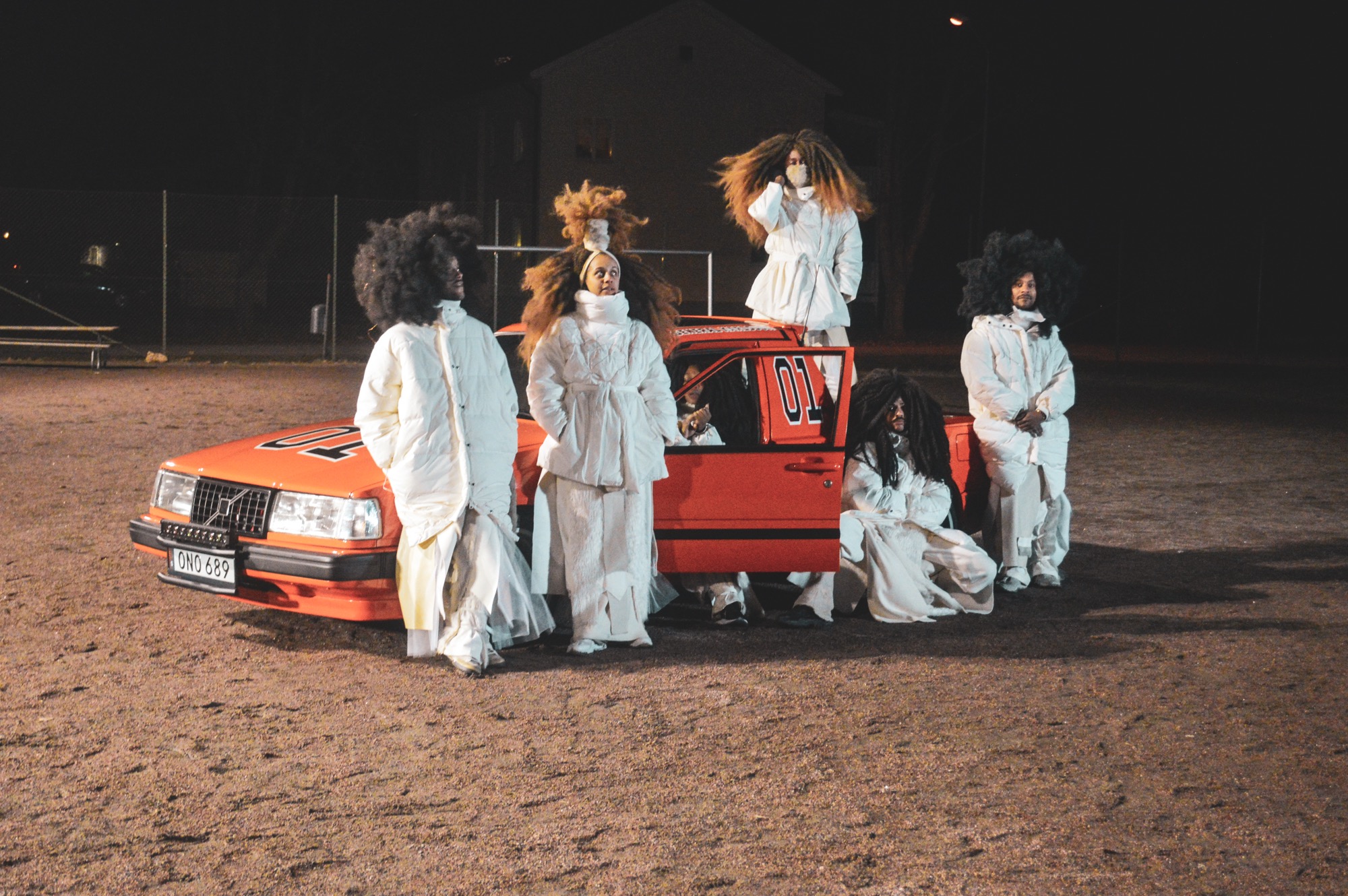
FutureBlackSpace, 2021. Fashion design and styling: Camilla Wellton.
My music was selected for Alicia Verdés’s film I’m Back Baby. I also began working with John-Paul Zaccarini on FutureBlackSpace at Stockholm University of the Arts, making costumes and contributing styling, images, editing and music. The film was released in 2021.
I began developing I AWAKE, a world of books, voice, original music and guided practice. During 2021 and 2022 I also contributed costume, styling, photography and image editing to John-Paul Zaccarini’s FutureBrownSpace. Imagined worlds were becoming a more central part of my working life.
I returned to We Got Cookies and gave the accessories brand a new beginning. Leather, silhouette and the pleasure of dressing were ready for another chapter.
I founded Sensual Institute as a home for education, publishing and the study of how we experience being alive. It also became the publishing home of I AWAKE. I wanted language, curiosity and bodily experience to meet somewhere people could enter.
On 30 September I published the nine-book Sensual Hero’s Journey series as part of I AWAKE. On 14 October I co-hosted a workshop on embodied dialogue at Samtidskonstdagarna in Uppsala. From clothing to books and shared practice, the work kept asking how we might meet ourselves and one another more fully.