
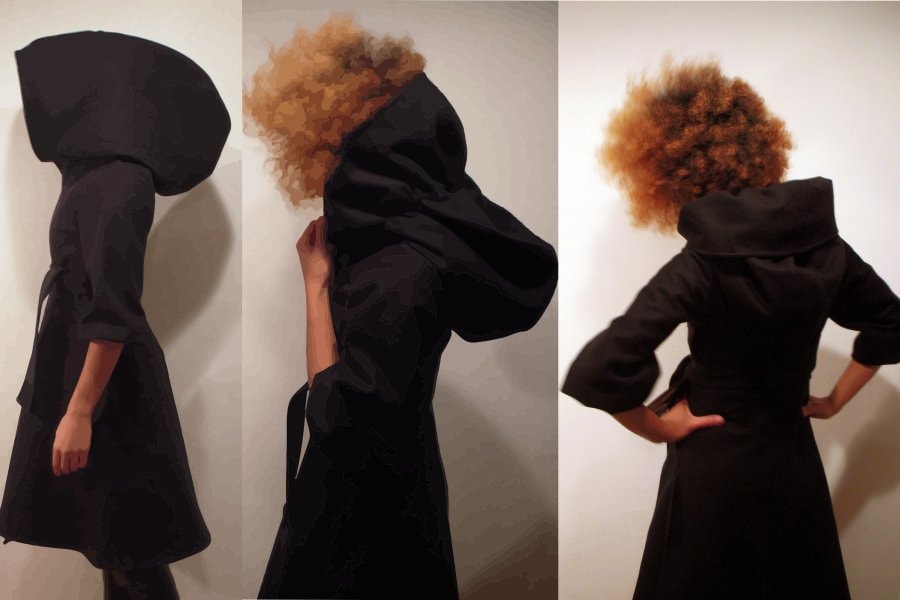
Image above from The Flowing.
Interviews, editorials and creative encounters trace Camilla Wellton’s work from the cutting table to the runway, the page and the screen. Explore the stories and the people who have looked closely at her practice. Camilla also edits The Human Work at Krull.
Dazed Digital · 2008
The idea changes when the cutting begins. Speaking to Anna Battista for Dazed in December 2008, Camilla Wellton describes a process in which a sketch is only the beginning. Patterns and trial garments allow her to discover what an initial vision can become. Some of the most important decisions happen with the work already in her hands.
The Dakini collection gives that process a particular form. Battista follows the broad sleeves and standing collar of the Kimonoat, the related Kimonacket and the way a fastening can become part of a coat’s identity. Her attention stays on the construction, where familiar kinds of clothing acquire an unfamiliar outline.
In her own writing about the studio, Camilla returns to the passage from flat material to a form that can be inhabited. She makes her patterns, toiles and first samples herself, leaving room to adjust a curve or reconsider how two pieces meet. A striking silhouette still has to accommodate a neck, an arm and the weight of its material. This is the close, practical work through which an expressive idea becomes something another person can put on.
That person also has a voice in the Dazed conversation. Camilla describes commissions developed with clients who bring wishes of their own. The finished garment carries decisions made together, adding an intimate dimension to the sculptural coats: an individual life has helped determine the shape.

A curved fastening, an expanded shoulder, the space around a torso: Krull’s close reading of Camilla Wellton begins with decisions made in cloth. The feature moves through the collections by examining what a garment permits its wearer to do, and how construction changes the relationship between a body and its surroundings.
The Rise supplies sharply shaped tailoring; The Water introduces a quieter balance of volume and exposure. The Awakening and The Fire offer different treatments of the upper body. The essay stays attentive to these differences, giving a seam or sleeve the same consideration as a finished silhouette. Its interest lies in the encounter between an individual wearer and a particular piece of clothing.
That encounter becomes especially tangible in Camilla’s costume work. For FutureBlackSpace in 2021, she designed and made outfits for six dancers, developed their hairstyles and worked as the on-set stylist. Clothing had to take its place within choreography, character and the camera’s frame. Her involvement continued through photography, moving images and music, connecting the dressed body with the wider presentation of the work.
Read together, the collections and that collaborative practice invite sustained attention to the designer’s choices. Krull’s feature offers an intimate route into them, moving from the recognisable outline of a jacket to the smaller construction decisions through which that outline becomes something a person can inhabit.
Image above from The Rise.

ANTARA News · 2013
Comfort is part of the design. In Nanien Yuniar’s February 2013 ANTARA profile, Camilla Wellton talks about making clothes that people can wear in everyday life. Her Eco Couture collection at Indonesia Fashion Week gives that intention visible form through clean cuts, restrained colours and attention to the construction of each garment.
Camilla’s interest in movement begins with the person inside the clothes. In her own writing, she considers what happens when a wearer sits, reaches or walks, and how those ordinary actions reveal something a still image cannot. A silhouette may invite a gesture or make someone newly aware of the space around them. The experience is individual: the person trying a garment discovers whether its shape belongs with the way she wants to move through her day.
Yuniar describes coats, long dresses, cardigans and jumpsuits, with pink appearing among black, white, cream and grey. Organic materials and a relatively spare surface keep the focus on cut. Camilla explains that pattern construction carries the expression, giving the collection its character without a reliance on decorative embellishment.
That makes the Jakarta collection especially interesting to examine at the level of proportion. The dress, coat and jumpsuit each offer a different answer to the same practical ambition. Elegance has to survive the passage from looking at a garment to living in it, with the wearer’s comfort included in the original idea.
Krull Magazine
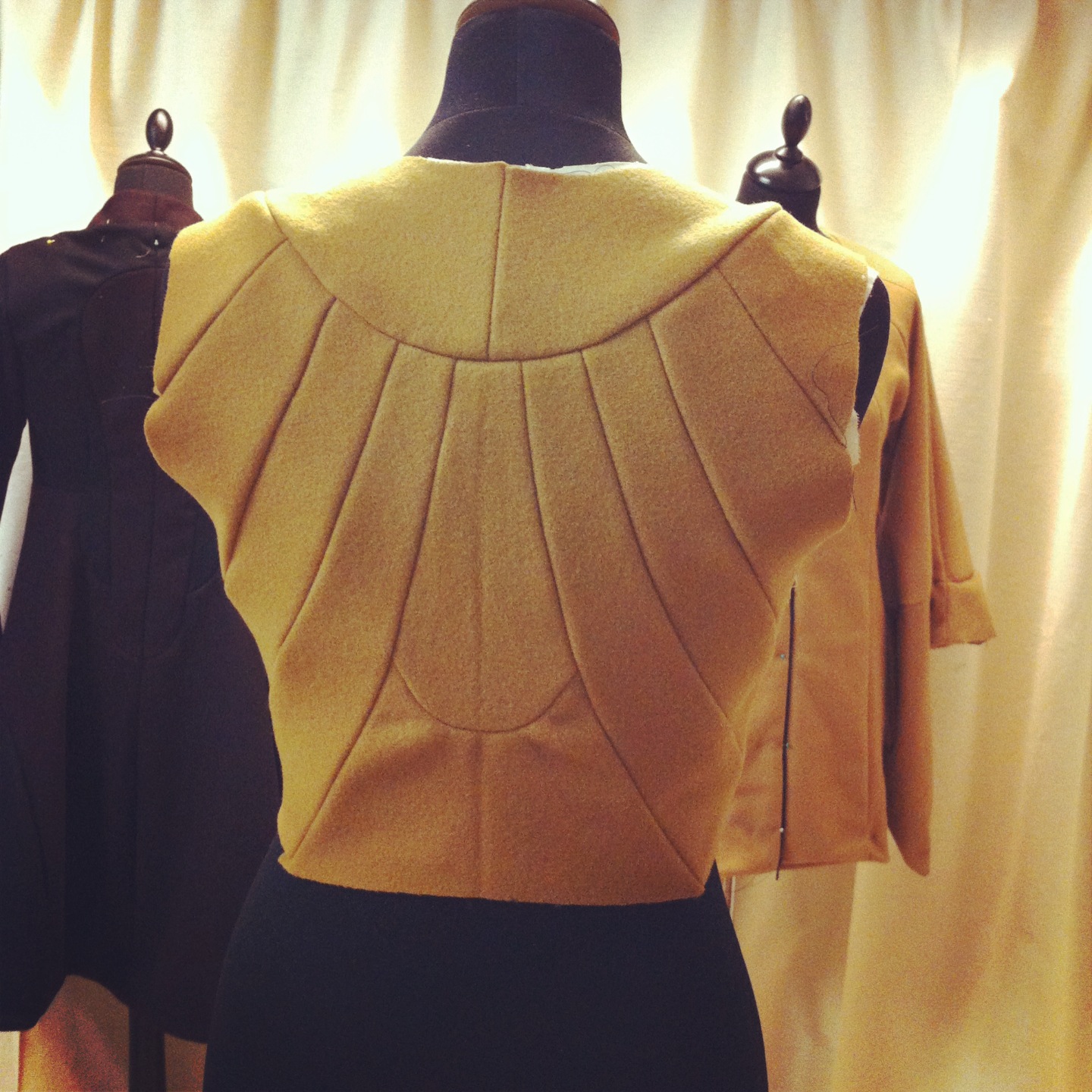
Camilla Wellton’s fashion history begins in Stockholm and expands through collections, public presentations and collaborations abroad. Krull’s encyclopedia profile brings those strands together, introducing the designer through her French Caribbean and Swedish background and the practical work of making patterns, toiles and first samples. The label’s beginnings in 2001 and its development into its later form in 2009 provide the early framework.
The profile follows Chix on Boards, created with Anna Wellton, alongside the sculptural collections that followed. It considers changes in proportion across jackets, dresses and sleeves, then widens its view to presentations beyond Sweden. Through these shifts, the work retains an interest in the relation between construction and the person who wears it. The fashion history also opens onto music, accessories and costume.
Camilla’s role in presenting Swedish design extended into the organisation of shows. For the Swedish cultural days in St Petersburg in 2006, she was invited to select three other fashion brands and lead the group. Her responsibilities included designing for her own label and choreographing the presentations. The task brought an individual collection into a shared undertaking, with several designers contributing to the image of Swedish fashion abroad.
That combination of making and organising gives the profile its breadth. It introduces a career through the clothes while leaving room for the stages, collaborations and working relationships that allowed them to travel.
Krull Magazine
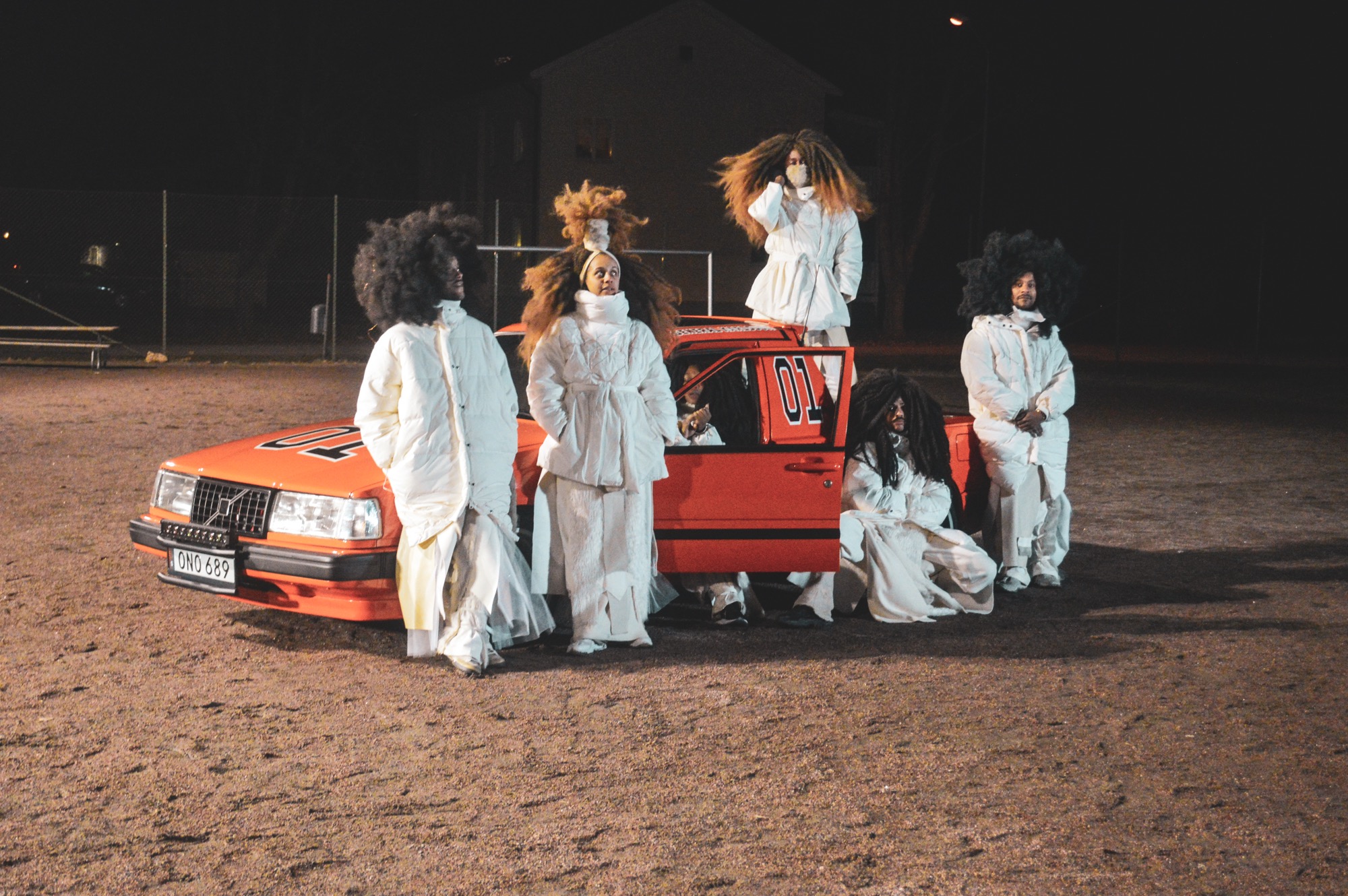
FutureBlackSpace, 2021. Fashion design and styling: Camilla Wellton.
White costumes around a red car; the same gathering set against a field of stars. The images in Krull’s portrait of John-Paul Zaccarini show how dress and image-making can establish the world of a performance before a viewer encounters it onstage. Camilla Wellton is credited with the costumes, styling, photography and editing of these published images.
The feature follows Zaccarini’s FutureBrownSpace and The AfroStar Galactica, an imagined voyage realised through performance, sound, scent and participation. It identifies Camilla as resident stylist and places her contribution within a larger collaboration. Toubab Holmes, Lucie Maisha N’Duhirahe and Aurelia Dey are among the makers and performers whose practices shape the work.
Camilla had also worked on the earlier FutureBlackSpace film in 2021. She designed and made outfits for six dancers, developed hairstyles and took responsibility for styling on set. Her work extended to filming and photographing the process, editing the accompanying film and composing its soundtrack. These responsibilities reveal how closely costume can sit beside the other decisions through which a performance becomes an image.
Krull’s account allows those contributions to be seen within Zaccarini’s artistic research at Stockholm University of the Arts. The clothes belong to an ensemble of bodies, voices and gestures. Their significance emerges through that company, as a shared visual world takes form around the people who inhabit it.
UltraLove / French Quarter Film
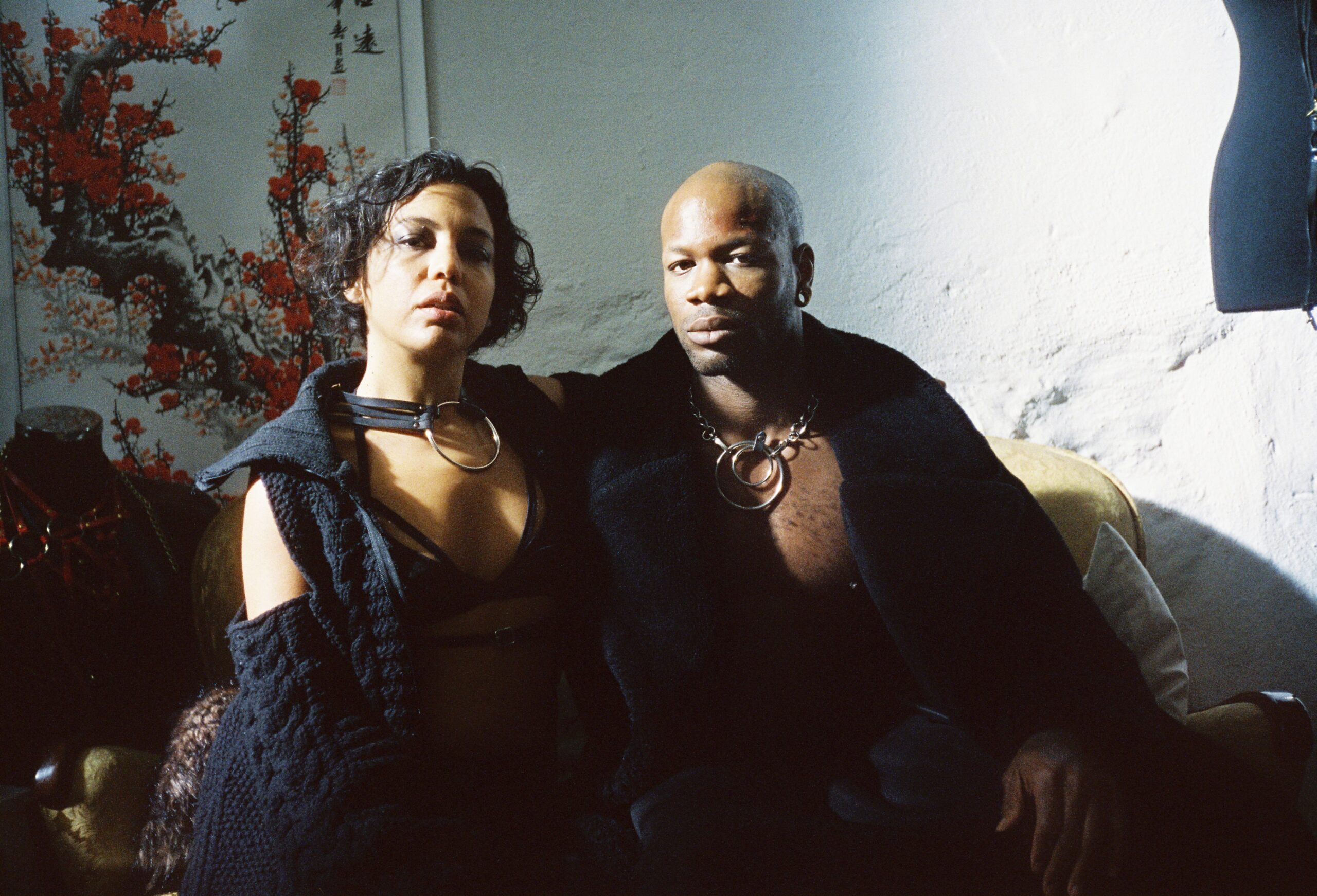
Image from UltraLove.
Clothing can speak before a character does. The way a person dresses may suggest confidence, hesitation, desire or the distance they keep from someone else. UltraLove brings Camilla’s costume and styling practice into cinema, where these small visual decisions become part of a story unfolding through faces, bodies and relationships.
Written and directed by Tobias Rydin, the film follows Clara and Luke as they explore intimacy and the possibilities of an open relationship. Its official presentation describes a story told in eight chapters, with colour, light and emotional change shaping its world. Camilla is credited as stylist among the film’s creative team.
Wardrobe belongs to the intimate scale of such a story. Clothes sit close to the body, accompany changes in circumstance and remain present when a character has little to say. Camilla’s contribution draws on her work in both costume design and styling, disciplines that join making with an attention to people. A look has to belong to the film’s world and remain convincing within a performance.
UltraLove’s own presentation brings together its imagery, story and creative team. Looking through it, clothing can be considered as one part of a larger visual conversation, alongside light and setting. The fascination of this work is its proximity to the characters: design experienced through the unfolding of a life, one scene at a time.
ELLE Sweden · 2015
For one evening in August 2015, Stockholm’s fashion programme invited people out into the shopping streets. ELLE’s Lisa Arnell mapped Fashion Night in Bibliotekstan, where late openings and events gave the city another way to encounter its designers. Camilla Wellton was among the names visitors could discover in a temporary Swedish fashion shop.
Camilla had already spent years thinking about how those encounters could happen. Through Fashionstreet, she brought designers, music and shopping together, giving people the opportunity to see collections and buy directly from their makers. Producing the events meant finding participants, coordinating collaborators and shaping presentations. It was work that began with the clothes but reached into the experience around them: who would be there, how the designs would be seen, and how a conversation could begin.
The 2015 pop-up brought that public encounter into central Stockholm. A collaboration between the Swedish Fashion Council and Bibliotekstan, it occupied Smålandsgatan 12 and gathered a range of Swedish labels. Arnell’s guide placed it among the evening’s destinations, alongside the activities unfolding across the surrounding streets and shops.
There is pleasure in revisiting the company Camilla kept here: established names, independent labels and emerging designers sharing the same city programme. ELLE’s invitation leads back to a particular moment in Stockholm fashion, when a collection could be discovered simply by stepping inside.
Irenebrination · 2009
A doctor’s bag given to Camilla by her father became the starting point for a new family of accessories. In Anna Battista’s October 2009 Irenebrination interview, that personal object sits alongside sculptural coats and a pale Spring/Summer collection. Together, they show a designer moving between the silhouette of a whole outfit and the things carried with it.
The Shivago collection included wallets, a laptop carrier and a travel bag, translating the original bag’s appeal into different uses. Battista’s questions give these smaller objects a place within the same conversation as Camilla’s clothing, following an idea as it changes scale and finds another practical purpose.
Accessories would remain part of Camilla’s work through We Got Cookies, where she has designed leather pieces and directed the brand’s visual expression. Her involvement extends from the object into photography, moving images and the way a collection is presented online. It is an approach that keeps design and presentation close together. A piece has its own construction and use, while the images around it help someone imagine how it might enter their wardrobe and their life.
In 2009, the new accessories accompanied a Stockholm Fashion Week presentation at Ateljé Ciresia. Battista also explores the collection’s organic fabrics and the hemp-and-silk Venus pieces, with photographs by Emma Jönsson Dysell. The feature invites a closer look at how these different objects belonged to one developing design language.
Irenebrination · 2008
Anna Battista’s Kimonoat had already left the world of collection photographs and entered her everyday life. Writing from Glasgow in June 2008, she describes wearing it through a rainy summer and reaching for it when she wanted a particular feeling of presence. Her account begins with a wearer’s attachment to a specific garment.
She notices the coat’s generous sleeves, upright collar and integrated bag, then turns to an earlier conversation with Camilla. The discussion moves between the details of construction and the reasons someone might want to make or choose their own clothes. For Battista, the pleasure is personal as well as visual.
Camilla’s own writing gives that relationship room to change. A person may want a clear outline on one day and softness or a sense of space on another. Clothes can give those preferences a physical form without asking the wearer to remain the same. Her interest begins with that private experience of getting dressed and extends towards the woman who chooses her work, bringing another history, another mood and another way of occupying the garment.
Battista gives the coat that second life on the page. She wears it, examines it and returns to the designer with questions about identity and expression. The resulting portrait holds maker and wearer together. Its intimacy comes from the attention paid to something that has become part of an ordinary day.
IndoConnect · 2014
A garment carries the traditions of its making into every new setting. Priya Ramakrishnan’s 2014 IndoConnect feature moves through Indonesian textiles and contemporary fashion, considering how inherited techniques find expression in the present. Within that wider story, she names Camilla Wellton among the international designers who participated in Indonesia Fashion Week 2013.
The article travels from regional weaving traditions to the programme in Jakarta, where Indonesian designers appeared alongside invited participants from Sweden, Malaysia, Brazil and the Netherlands. Clothing becomes a meeting point between different materials, histories and approaches to dress. Camilla’s appearance belongs to that international conversation around an Indonesian fashion event.
Earlier in her career, Camilla had combined presenting her own designs abroad with helping other designers present theirs. For the Swedish cultural days in St Petersburg in 2006, she worked with Art East as a designer, team leader and choreographer. The responsibilities reached beyond an individual collection into the preparation of a shared presentation. Bringing clothes into a new cultural setting also meant working with people, making decisions together and giving each contribution a place within the event.
Ramakrishnan’s feature opens a wider window onto the Jakarta appearance. The textile histories matter as much as the names on the programme. Following them gives the clothes around Camilla’s collection their own specificity, and makes the encounter between visiting and local designers more interesting to explore.
ANTARA News · 2013
Before a fashion week opens, its programme begins to suggest the conversations that might happen there. ANTARA’s February 2013 announcement placed Camilla Wellton alongside Samuel Cirnansck, Melinda Looi and Addy van den Krommenacker as four invited international designers at Indonesia Fashion Week. Sweden, Brazil, Malaysia and the Netherlands would join a much larger Indonesian gathering.
The event brought designers and brands into contact with buyers and the public in Jakarta. Its organisers described different areas of fashion within the programme, including an educational focus on environmentally conscious clothing. The international invitations belonged to an ambition to connect Indonesian design with people and practices beyond its own market.
Camilla’s experience as a designer also includes the work of putting a presentation together. She has planned events, choreographed shows and directed the visual expression of her label. These responsibilities ask for attention to the relationships around a collection as well as to the individual pieces. Clothes are presented in a sequence and in the company of other work; music, images and movement can all participate in the way an audience begins to understand them.
The announcement catches Indonesia Fashion Week with those possibilities still ahead. Its participating names suggest different approaches meeting within one programme. For Camilla, the invitation offered another setting for her designs, among a group assembled around both the creative expression and the practical business of fashion.
Fotosidan · 2012
The light was already there. For Jord, Morgan Norman photographed Camilla Wellton’s clothes near the entrance to his studio, where daylight gave him the conditions he wanted. Amy Lagerman’s September 2012 Fotosidan article follows the making of the images before their exhibition at Stockholm’s Scandic Malmen.
Camilla and Norman had also worked together on Space at Play, a gallery project made with Mälardalens Högskola. Camilla brought her collection into a setting shared with photography and live music, taking responsibility for the event’s creative direction and production. The collaboration gave clothing several ways to be encountered at once. A garment could be seen as an object, become part of an image and enter the atmosphere of a performance, while remaining connected to the person who made it.
For Jord, Norman worked with dark fabrics and reflectors around the available light. He also experimented with separating the lens from the camera body, allowing unexpected blur and light into some images. Lagerman names the hair, makeup, styling and modelling collaborators, acknowledging the different contributions behind the photographs.
The resulting exhibition brought fashion close to nature and art through its treatment of clothing and atmosphere. What draws the eye is also a set of working choices: where to stand, how to shape the light and when to allow an element of unpredictability. Camilla’s designs become part of that photographic conversation.
Sublime · 2012
A material decision can be the beginning of a design conversation. In August 2012, Sublime introduced a Stockholm showcase organised by Sustainable Fashion NOW, with Camilla Wellton among the participating designers. The event brought questions about waste, production and working conditions into the same programme as contemporary clothes and individual creative expression.
Uniforms for the Dedicated and Ida Wadenrud also appeared in the line-up. Taking inspiration from London’s Estethica initiative, the organisers wanted designers to keep room for imagination while working with recycled or sustainable materials. The planned presentation at F12 Terrassen gave those ambitions a public setting within Stockholm’s fashion calendar.
Camilla’s writing about fashion asks the viewer to carry curiosity beyond the first image. The qualities that make a garment appealing can lead to questions about its material, construction, use and care. Her own studio practice includes pattern cutting and sampling, bringing the imagined shape into contact with something that has weight and texture. Looking closely at a garment can therefore deepen the pleasure of it: the eye begins to recognise the choices that allow the form to exist.
Sublime’s preview holds that creative curiosity alongside the responsibilities of production. The designers were being brought together around a shared concern, with space for different visual answers. The appeal lies in discovering how those commitments could appear in the clothes themselves, through a particular fabric, silhouette or way of making.
Organic Spa Magazine · 2012
The Thunder Jumpsuit gives a summer outfit a clear starting point. Zoe Helene selected it for Organic Spa Magazine’s April 2012 editorial Easy & Elegant, placing Camilla Wellton’s design among pieces chosen for understated dressing. The eye can follow a long silhouette before turning to the smaller accents around it.
In Camilla’s practice, clothing has long accompanied an attention to the body. She has taught yoga, run a studio and worked with movement in fashion presentations. Her writing also considers how the experience of an outfit changes with music, setting and the person wearing it. The clothes offer a form, but the day supplies another part of their character. A garment can remain the same while the wearer finds a different rhythm, association or way of carrying herself inside it.
Helene describes the Thunder through its halter neckline, close shaping around the body and fuller legs. Its organic modal fabric receives particular attention, bringing touch into the description of an otherwise strongly visual piece. Jewellery completes the editorial look, adding another scale of detail around the clean outline.
The selection makes it possible to spend time with one design rather than a whole collection. Follow the proportion from neckline to hem, then consider what the accessories contribute. The jumpsuit holds the look together while leaving room for those other choices, each changing the emphasis without losing the clarity of the original shape.
ScandAsia / China Daily · 2011
Camilla’s work carries several influences when it appears under the name of Swedish design. Born and raised in Stockholm, with French Caribbean and Swedish heritage, she brings an individual history to that introduction. Her own writing considers how a collection shown abroad can become part of someone else’s picture of a place. A national description begins the encounter; the particular shapes and decisions of the designer give it detail, inviting the viewer to look more closely.
In 2011, the Swedish Institute’s Eco Chic exhibition brought her work to Shanghai. This feature, published by ScandAsia from China Daily’s coverage, places Camilla among Swedish designers whose approaches to clothing raised questions about materials and environmental responsibility. Chinese designers and students joined the exhibition, extending the conversation across different practices.
The article follows choices in sourcing and production while allowing room for gradual changes. Camilla speaks about the connection between personal expression and the environment. Other participants bring their own concerns, giving the exhibition several points of entry into a subject that touches both the maker and the person choosing clothes.
Shanghai becomes a place to consider those approaches together. The interest is in their differences as much as their shared theme: an exhibition can let one designer’s material choice sit beside another’s method of production. Camilla’s clothes participate in that exchange, carrying a distinct point of view into a larger discussion.
The Baltic Course / LETA · 2011
At Tallinn’s Hopner House in May 2011, fashion and jewellery shared a place in the city’s cultural programme. The Baltic Course, carrying LETA’s report, named Camilla Wellton among the Nordic designers represented in an exhibition on Town Hall Square. Clothing was being encountered as part of a wider presentation of contemporary design.
The exhibition belonged to Tallinn’s year as European Capital of Culture and involved Nordic cultural organisations and embassies. Collections from several countries appeared together, offering visitors different approaches to dress within the same setting. The format allowed individual objects to become part of a conversation across disciplines and borders.
There are several ways to follow those objects in Camilla’s wider collection archive. In The Rise, for example, the relationship between a defined waist and expanding outer volume gives the eye a route around a coat. Broad sleeves, upright collars and large hoods change the spaces near the arms and face. Looking at those relationships makes a garment more particular. A national or stylistic label gives way to the decisions that someone has made about a body and the shape surrounding it.
The Tallinn programme brought such individual design languages into company with one another. Its participating names provide a starting point for exploring that company, and for considering how a piece of clothing can hold its own identity while contributing to the character of a shared exhibition.
Finding Eco · 2010
An unfamiliar outline can make the eye linger. Finding Eco’s May 2010 feature approaches Camilla Wellton’s Spring/Summer collection through its architectural shapes, restrained colours and futuristic character. The writer responds to the presence of the clothes as well as to the material choices behind them, treating ecological design as a place for visual invention.
That interest in the space around a body can be followed across Camilla’s collections. The Surreal uses rounded openings, overlapping fronts and a large hood to alter the relationship between the waist and the surrounding volume. In The Flowing, pale surfaces make folds and crossings visible while the garments retain their structure. The shapes offer different ways of framing a person. Looking from one collection to another brings those decisions into focus, with each arrangement giving familiar clothing another possibility.
Finding Eco sees a related tension in the 2010 work: natural and organic materials appear in clothes whose forms suggest a speculative world. The feature also turns towards made-to-order possibilities, linking the visual proposition to an individual wardrobe. Images give the reader room to follow the outlines that first drew the writer’s attention.
The fascination lies in that meeting of material and imagination. A coat or dress can begin with something tangible and still suggest a way of dressing that feels unfamiliar. This early response to Camilla’s collection invites the eye to move between those two qualities and notice how they belong together.
Ragtrader · 2009
Eight coats and jackets formed the proposed introduction to Australia. In November 2009, Ragtrader reported that Camilla Wellton was preparing a capsule for the country’s autumn/winter 2010 season. The trade publication considered the collection through a retailer’s concerns, bringing the range, its fabrication and potential stockists into focus.
Running an independent label had made Camilla familiar with the decisions surrounding a collection. She designed the clothes and cut their patterns, while also developing the images, written material and online shop through which people could discover them. The creative work continued into the task of explaining what had been made and helping it reach an audience. Moving between these responsibilities was part of the daily life of her company, with the garments giving the different activities a common purpose.
Ragtrader described wool pieces manufactured in Sweden and northern Europe, with conversations underway with retailers in Melbourne and Sydney. The plans placed Camilla among Swedish labels exploring the Australian market. A collection developed in one setting was being considered for another, with its next commercial steps still to be decided.
A capsule asks each piece to contribute to a considered whole. Here, outerwear supplied that focus, keeping the introduction centred on coats and jackets. The story opens a different perspective on the designs: the same garments that invite attention to cut and silhouette also need to find their place in shops, wardrobes and the lives of new wearers.
The Spin Off · 2009
A runway takes on a particular significance when much of a fashion week has moved elsewhere. Reporting on Stockholm’s spring/summer 2010 season, Emma Holmqvist names Camilla Wellton among the few designers who staged catwalk presentations. Her August 2009 account for The Spin Off places the show within an industry feeling the effects of the recession and finding different ways to introduce its collections.
The city was still making fashion visible. Designers invited buyers and journalists into showrooms, screened films and presented work in shops. Holmqvist follows those changes alongside the trade fairs and emerging labels, giving Camilla’s appearance a precise setting within the Swedish fashion business of the time. Her account connects the shows with the commercial activity taking place across the city.
For Camilla, the work surrounding a collection has long included more than designing garments. Her practice encompasses pattern cutting, creative direction, event production and the coordination of collaborators. Making the clothes and deciding how people encounter them are closely connected tasks. A silhouette has to work on a body; a presentation has to give that silhouette the time and setting to be understood.
Seen from that perspective, this report catches an important public moment in the label’s development: Camilla putting a collection into motion while Stockholm’s designers explored how a fashion week could take shape under changing conditions.
Thatsup · 2009
Mariatorget 1C: an address anchors Camilla Wellton’s place in Stockholm Fashion Week’s public programme of August 2009. Thatsup’s city guide directs readers to Ateljé Ciresia for The Coats and the Jackets, with an exhibition running from 10 to 16 August and a runway presentation scheduled for the evening of 14 August.
The invitation offered several ways to meet the collection. Visitors could see the exhibition, arrange a showroom appointment or attend the show. A garment could be encountered at different speeds, through the concentration of a presentation or the closer attention of a visit. The guide places Camilla alongside other events welcoming people beyond the professional fashion audience, opening the city’s fashion calendar to its inhabitants.
Ateljé Ciresia was also a place where Camilla had taught yoga. By 2009, she had established YoginiNation on Södermalm, bringing together teachers with different approaches. Her work with clothing and her teaching developed alongside one another, each involving attention to the body in movement. Those parallel practices form part of the background to a collection devoted to two familiar, physically enveloping garments.
The original guide preserves the scale of this encounter: one Stockholm address, a week of access and a particular evening on the runway. It brings the coats and jackets back into the neighbourhood where people could first see them.
Krull Magazine
Fashion, sound and writing meet in Krull’s portrait of Camilla Wellton’s wider practice. The Future Has a Body follows the continuity between these forms, asking how a maker concerned with clothing can carry an interest in perception and participation into music, books and new institutions. Its subject is a creative practice with several points of entry.
The article moves from garments and costume into GYNDROID, Camilla’s musical identity, and the connected books and experiences of I AWAKE. It also introduces the Sensual Institute and the Swedish Institute of Inner Technology. Each has its own name and purpose; the feature considers the person whose work connects them. Sound, a page and a garment offer different kinds of contact with an audience.
Camilla’s working vocabulary has long crossed disciplines. Alongside fashion design and pattern cutting, her practice includes photography, retouching, video editing, graphic design and electronic composition. She has worked on both the object and the image that presents it, carrying projects from an initial idea through their visual expression. The breadth is practical: making a costume, shaping a soundtrack and editing a film require distinct skills and sustained attention to their relationship.
Krull gives these activities space to be considered together. For readers who know the collections, the portrait opens another part of Camilla’s world, tracing how the concerns of a designer continue through the experiences she creates for listeners and readers.
Krull Magazine
Toussaint Ishimwe brings his own taste and personality into Krull’s fashion editorial. Asked which trend he would revive, he chooses men’s flared trousers and invokes the style of the 1970s. Asked about a recent surprise, he speaks about completing university. The conversation gives the fashion images a person to return to, with friendships, preferences and a life beyond the frame.
The editorial is photographed by Andrea Davis Kronlund, with fashion direction by RL Pearsall, styling by Samantha Braun and makeup by Emelie Wood Olsson. Camilla Wellton and We Got Cookies appear among the credited brands. Krull presents Toussaint through an Afrofuturist sensibility, while the title acknowledges the historical figure whose name he shares, Toussaint Louverture.
The presence of both labels brings together two parts of Camilla’s design practice. Her work under her own name includes garments and pattern construction; We Got Cookies extends her design into leather accessories. Within that venture, her responsibilities have included creative direction, product design, photography, moving images and the presentation of the brand. The accessory therefore belongs to a wider visual language, considered through both its construction and the ways it is worn.
Here that language enters a collaboration led by other image-makers. The full editorial offers the opportunity to see how the credited clothes and accessories participate in a fashion portrait centred on Toussaint’s particular presence.
World Fashion Exhibition
Environmental science in Hawaii, philosophy and astronomy in Stockholm, and later studies in entrepreneurship: Camilla Wellton’s route into fashion crossed several disciplines. World Fashion Exhibition introduces that breadth in its profile of the designer representing Sweden. The name at the centre of the country’s presentation belongs to a Stockholm-based maker of French Caribbean and Swedish heritage, whose education developed alongside an increasingly practical commitment to design.
The profile dates the label’s foundation to 2001 and its later form to 2009. It describes clothes shaped by unusual cuts and carefully considered proportions, bringing simplicity and intricacy into the same silhouette. Camilla’s work as a pattern constructor is central to this introduction. Her individual approach is presented through the decisions that give a garment its structure, its outline and its relationship with movement.
Camilla’s working life also connects the making of an object with its visual presentation. Her experience includes creative direction, photography, styling and event production, alongside the design of the clothes themselves. These responsibilities give a wider setting to the international profile. A country heading offers an immediate point of recognition; the designer beneath it brings a particular history, set of skills and way of seeing. World Fashion Exhibition’s Sweden page invites readers into that individual practice through the label’s origins and the interests behind its form.
Bibliotekstan · 2015
For three days in August 2015, a shop on Smålandsgatan became a meeting point for Swedish design. The Swedish Fashion Pop Up Store opened at number 12 during Stockholm Fashion Week, bringing clothing and accessories into Bibliotekstan through a collaboration with the Swedish Fashion Council. Camilla Wellton was among the participating labels.
The selection crossed categories: ready-to-wear, shoes, jewellery, bags and eyewear. Designers could present their work and sell their collections in the same place. The programme continued into Fashion Night on 26 August, when further names from Swedish Fashion Talents joined the store. Bibliotekstan’s announcement captures the pop-up as a temporary gathering of distinct businesses within one of Stockholm’s established fashion districts.
Direct encounters with an audience had already been part of Camilla’s work through Fashionstreet. That Stockholm initiative brought designers together with catwalk presentations, live music and opportunities for visitors to buy or order collections. Camilla developed the concept, coordinated participants and showed her own work. Presenting fashion involved creating a setting in which a visitor could move from looking at a garment to choosing it.
The Bibliotekstan collaboration gave that encounter a different address and scale. Its original announcement preserves the company Camilla’s label kept, the mix of work on offer and the invitation to experience Swedish fashion through the proximity of a shop floor.
Swedish Fashion Council / Women in Progress · 2014
A fashion label needs structures that can support its creative work. In 2013, the Swedish Fashion Council and Women in Progress brought smaller fashion businesses into contact with experienced board candidates through a development initiative supported by Tillväxtverket. The Designs of Miss Camilla Wellton was among the participating companies.
The initiative considered how outside expertise could contribute to decisions, planning and growth. Its account introduces the participating labels as businesses with individual identities. Camilla’s profile describes a combination of feminine elegance and a futuristic edge, with collections presented through couture, made-to-measure and ready-to-wear. Ecology and ethics also appear among the label’s stated priorities.
That business setting belongs beside the designer’s practical experience. Camilla studied entrepreneurship and project leadership, and her work has encompassed the coordination of collaborators, communication with partners, creative direction and event production. A collection requires decisions about much more than its final appearance. How a project is organised affects the time, skills and relationships available to make it, and to bring it to an audience.
Strategiskt styrelsearbete opens this less visible part of the fashion world. It places Camilla among independent Swedish businesses working through questions of organisation and development, allowing the reader to see the company behind the clothes. The result adds a useful dimension to a career often encountered first through silhouettes, photographs and runway appearances.
Ethical Fashion Forum / Global Social Economy Forum · 2013
Environmental questions entered Camilla Wellton’s life through study as well as through clothing. Her education included environmental science in Hawaii and Stockholm, alongside chemistry, physics and mathematics. Entrepreneurship and project leadership followed. The study of natural systems and the practical organisation of a business became distinct parts of the same professional history. Her appearance in the Ethical Fashion Forum’s international network places the label within a wider discussion of responsibility in fashion.
In Seoul in 2013, Sarah Ditty presented that discussion through the work of SOURCE. Camilla appears as a member in an account of how designers, suppliers and businesses could share knowledge and develop different ways of working. Ditty considers sourcing, labour, environmental standards and the infrastructure needed to support change. Information, professional relationships and opportunities to meet all have a place in the approach she describes.
The presentation then looks towards South Korea, considering how a fashion initiative could learn from existing experience and connect with an international community. Camilla’s inclusion brings a Swedish label into that setting. For readers interested in the ecological concerns surrounding her collections, the presentation opens a view of the industry conversation taking place around them. Its emphasis is on sustained professional exchange: how people who design, source and make clothing might work together on the conditions through which a garment comes into being.
World Fashion Week · 2013
Indonesia Fashion Week’s second edition brought local and international design into the same programme over four days in February 2013. World Fashion Week’s retrospective looks back on that encounter, placing Camilla Wellton alongside Addy van den Krommenacker, Samuel Cirnansk and Melinda Looi among the visiting designers presenting their work in Jakarta.
The account gives substantial attention to Indonesia’s own fashion community. It considers the country’s designers, the place of batik and the possibilities of exchange with international collaborators. The organisers describe an event shaped by both the domestic industry and its ambitions abroad. Camilla’s collection appears within that wider setting, one contribution to a programme bringing different approaches to design before the same audience.
Camilla’s own formation crossed languages and places. Educated at the Lycée Français Saint Louis in Stockholm, she later studied in Hawaii and continued her studies in Sweden. She speaks Swedish, French and English. That background sits behind a Swedish label repeatedly presented to audiences abroad, with each encounter placing its clothes in a different cultural setting.
The Jakarta retrospective follows another such meeting across borders. Its interest lies in the surrounding conversation as much as the individual appearance: who was showing, what the host city’s designers were developing, and how an international programme could create contact among people working in different fashion cultures.
World Fashion Week · 2013
Twenty-one countries were represented in World Fashion Exhibition’s presentation at Indonesia Fashion Week in February 2013. Sweden’s contribution was Camilla Wellton. The exhibition occupied the lobby of the Jakarta Convention Center, bringing designs from across five continents into a setting where visitors could encounter the work beyond the rhythm of the runway programme.
The organisers framed the exhibition around cultural exchange and the social role of fashion. Their account names each participating designer alongside a country, placing Camilla within a group that included different traditions and approaches to dress. It also sets out the exhibition’s ambition to connect fashion with wider questions of opportunity and development. The complete list gives the Swedish contribution its international company.
Exhibition-making was already part of Camilla’s practice. Space at Play, developed in 2011 with Mälardalen University and photographer Morgan Norman, brought her collection into Galleri Aguéli over several days. Musicians joined the programme, and Camilla worked across creative direction, event production and the fashion presentation. The clothes could be considered through their relationship with images, sound and the place in which they were shown.
Jakarta offered a further way for a collection to meet a public. World Fashion Week’s account preserves the breadth of the gathering, inviting a reader to place Camilla’s work among the designers whose individual contributions formed this international exhibition.
World Fashion Week · 2013
The clothes on Camilla Wellton’s Jakarta runway were intended to be worn. In World Fashion Week’s account of her February 2013 presentation, a neutral palette, open necklines and flared skirts lead into a conversation about bodily ease and the materials from which garments are made. Camilla speaks about movement and breathing as essential considerations in the design.
Her explanation connects environmental concern with everyday clothing. The interview describes her use of organic fabrics where possible, including silk and cotton sourced from Jaipur, and her interest in the effect of material choices on natural systems. These were the choices she discussed during her first visit to Indonesia, as she introduced the collection to a new audience.
Attention to the moving body also had a practical place elsewhere in Camilla’s life. She taught yoga, led workshops and brought together a group of teachers at her own Stockholm studio. Her design practice included pattern cutting and developing garments from an initial idea into a finished piece. Teaching movement and making clothing were different kinds of work, each requiring close attention to how a person inhabits physical space.
The Jakarta interview lets those concerns meet in the designer’s own explanation of the collection. It offers a view of the reasoning behind its appearance: the relationship between a chosen fabric, a considered silhouette and the freedom a wearer needs to move through an ordinary day.
Galleri So Stockholm
A garment changes when it leaves the studio. Someone sees it from across a room, comes closer to its fabric, then begins to imagine wearing it. Camilla’s appearance in Galleri So Stockholm’s calendar belongs to that direct encounter between an independent designer and the city around her: a shared pop-up bringing Swedish labels together in Stockholm.
The gallery lists Camilla on the Friday of a two-day May event, alongside names including SÄBY, Ballerina Closet and Sapmi Couture. Set within a calendar that moves between art, design and public gatherings, the listing places fashion among the other creative lives of the city. It is a glimpse of clothes finding their audience through a temporary, shared space.
Stockholm has also been the setting for Camilla’s own experiments in bringing people together around fashion. Space at Play combined her clothes with photography, art and live music; elsewhere, her work has moved between designing, staging and organising presentations. These activities give the pop-up a natural place in the story. A collection needs its carefully considered forms, but it also needs occasions when people can discover them without a screen between the fabric and the eye.
The gallery’s full calendar opens onto that lively local world. Among exhibitions and gatherings, a temporary shop becomes a small but telling chapter: independent clothes entering the shared spaces of a city, meeting their neighbours and finding new company.
Embassy of Finland, Tallinn · 2011
Across the Baltic, a temporary shop became a meeting place for Nordic design. In May 2011, Nordic Look brought Camilla’s work to Tallinn, placing her fashion within a wider exchange of ideas about clothing, materials and the way design enters daily life. The setting was Hopner House on the city’s Town Hall Square.
The Embassy of Finland’s announcement describes a shop running from 2 to 29 May, with work by fourteen Nordic makers. Organised by the Nordic Council of Ministers’ office in Estonia with Nordic embassies and cultural institutions, the programme also included seminars, workshops and concerts. Camilla was introduced as a Swedish designer working with eco couture, among an international selection of distinct approaches to fashion.
The phrase eco couture placed an emphasis on both care and making. For Camilla, whose work has involved fashion design and pattern cutting as well as presenting her collections internationally, those activities belong together. An idea has to become a form that can be understood through its proportions and experienced on a body. Taking it to another city creates a fresh encounter between the designer’s decisions and the person looking at the clothes.
The embassy’s account gathers the people and organisations behind this exchange. Nordic Look gave the collections a cultural setting as well as a place to be seen: an invitation to consider what clothing might bring to a conversation between neighbouring countries.
RNB Retail and Brands / Sisters · 2011
A design begins with an idea, but its next life depends on someone recognising what it could become. In February 2011, Camilla was named among the fifteen designers selected for Sisters Academy, a programme created by the Swedish fashion retailer Sisters. The announcement captures a moment when individual creative work was being invited towards a wider retail audience.
RNB’s account describes a selection made from hundreds of applicants. The chosen designs were intended for a limited edition in Sisters stores that spring, giving the programme a practical ambition beyond the selection itself. Camilla appears in the announcement among the Stockholm designers selected for this collaboration.
How might a creative proposal become part of someone’s wardrobe? That passage holds a particular fascination for a maker. Proportion must survive construction; a silhouette must make sense in movement; the intention must remain clear beyond the first sketch. As both designer and pattern cutter for her own label, Camilla worked across those stages, while also taking responsibility for styling and presenting the finished clothes. Sisters placed that independent experience beside the possibilities of retail collaboration. Its full selection brings together fifteen different starting points, each with an idea of what a woman might want to wear. For Camilla, this was one of the moments when a personal design language was invited into a shared commercial setting, opening another route between the studio and everyday life.
Ethical Fashion Forum / SOURCE Network · 2010
Fashion’s responsibilities extend beyond the finished silhouette. They reach into materials, working relationships and the decisions that allow a collection to exist. When the Ethical Fashion Forum looked ahead to 2010, managing director Tamsin Lejeune included Camilla among the new members whose work had caught her attention during the network’s growth.
The January article looks back on a community that had expanded across more than seventy countries. Its plans for the coming year centred on connections between designers, buyers and suppliers, with particular attention to ethical and fair trade production. Camilla’s collection appears within that conversation: an independent practice entering a network concerned with how fashion is made as well as how it looks.
There is an ordinary, demanding side to that ambition. Every collection is built from decisions: what to make, how to cut it, which relationships to develop and what to ask of the finished garment. Camilla’s work within her own label included both design and pattern cutting, bringing the creative and practical questions into the same working life. The network offered a larger setting in which such questions could be discussed with others.
Lejeune’s article is especially interesting for that sense of connection. It catches ethical fashion in conversation with itself, looking for ways to bring people, knowledge and opportunity together. Camilla’s name appears within a community considering what its next steps could be, as well as what it hoped to change.
Research Catalogue / John-Paul Zaccarini · 2026
An imagined spacecraft can offer a different way to think about the world we inhabit. The AfroStar Galactica, part of John-Paul Zaccarini’s FutureBrownSpace, uses an audio journey to open questions of identity, imagination and belonging. Camilla appears among its Ground Crew, within a constellation of collaborators contributing to this artistic world.
As FutureBrownSpace’s resident stylist, Camilla brings another means of expression into that collective work. Clothes can help a body take its place within an imagined setting, while movement gives the clothes a life that cannot be planned entirely on paper. Her experience in costume and fashion meets a world made with voices, writing and performance. The Ground Crew credit recognises her place among the people gathered around this particular journey.
The Research Catalogue presentation places the journey inside a project at Stockholm University of the Arts that brings Black Study into dialogue with performance, writing and collective learning. Aurelia Dey guides the audio flight. The wider work considers how Black and Brown practitioners can make spaces for creative thought within institutions, using speculative imagination as one of its methods.
The audio is the way into the AfroStar Galactica. Listening allows the associations to unfold in their own time, alongside the images and the collaborators’ names. A spacecraft becomes an artistic invitation: somewhere to travel in imagination, and somewhere from which to look again at the ground beneath us.
Stockholm University of the Arts · 2020–2021
Six dancers, sculptural white costumes and a world taking shape through movement: Camilla’s contribution to FutureBlackSpace brought fashion into a collective artistic inquiry. Her work on the 2021 film included outfits, hairstyles and styling on set, translating ideas into forms that could be worn, moved in and brought to life by performers.
Stockholm University of the Arts identifies her as a collaborating fashion designer in John-Paul Zaccarini’s 2020–2021 research project. FutureBlackSpace created a setting for artists of colour to explore their experience through writing and embodied practice. Its questions concerned creative freedom, self-definition and the possibility of making work beyond expectations imposed from outside.
One image from the film’s world brings those disciplines together: performers in oversized wigs and white costumes gathered around a red car at night. The contrast gives the clothing an immediate presence, while the group remains its living centre. Camilla’s work extended across outfits, hair and styling, with concept-design assistance also forming part of her contribution. The university’s presentation offers the wider project and film alongside its collaborators. Seen together, the visual work and the research questions reveal different parts of the same undertaking. There are practical decisions about what a performer wears, and larger questions about the space in which that performer can create. Costume moves between them, making an artistic proposition visible through a body in motion.
Max Planck Institute for the Study of Societies · 2013
How does a fashion movement become a market, and what happens to its ideals along the way? Simone Schiller-Merkens asks that question in Framing Moral Markets, a study of ethical fashion published by the Max Planck Institute for the Study of Societies in 2013. Camilla’s label appears among the designers who exhibited at Estethica in September 2010.
The study examines how social movements help shape a new market category, looking at the language used to describe responsibility, environmental concerns and social justice. Its list of participating designers places Camilla within a particular moment in ethical fashion’s development, when different approaches were being brought into a shared industry conversation.
Clothes are intimate objects, yet the conversations around them reach far beyond the wardrobe. A designer may begin with a shape, while the same garment also raises questions about materials, work and value. Running her own label meant that Camilla moved between designing and pattern cutting, creative direction and the practical responsibilities of a small fashion business. These are different vantage points on the same object.
The study offers room to consider that relationship at a slower pace than a collection image allows. Its interest lies in the language through which people give fashion meaning, and in the way shared concerns become part of an industry. Camilla’s inclusion places her work within that unfolding discussion of what clothing might stand for.
Jade Mellor · 2011
A dress and a piece of jewellery can meet without either losing its own character. In Paris in November 2011, Camilla’s Venus dress was paired with Jade Mellor’s Panthera Leo white collar for the White Swan runway show. Mellor’s account follows that meeting from the perspective of the jewellery designer herself.
The show took place during Les Coulisses du Mariage at La Maison des Polytechniciens, following a contest organised by Carnet de Mode with Madame Figaro. Writing after her return from Paris, Mellor shares photographs taken around the event and identifies the dress that would carry her necklace. Her view moves close to the preparations, offering a personal account of a collaboration becoming visible.
For Camilla, whose work has included both fashion and leather accessories, the relationship between pieces is part of the pleasure of design. A dress sets out one arrangement of line and proportion; an accessory brings another. Styling considers how they might live together on a person, without requiring them to tell precisely the same story. This Paris pairing allows two makers’ work to enter that conversation.
Mellor’s photographs give the meeting a personal scale. Her attention moves from the setting to the clothes and jewellery, sharing the occasion through the things she noticed as a participant. The Venus dress appears within another maker’s account, a reminder that a garment’s life can continue through the eyes of the people who encounter it.
Jackie Puwalski / Shards of Decency · 2011
Imagine a fashion photograph beginning with the movement of a snow globe: a sudden disturbance, then a gradual settling. That was the idea behind Jackie Puwalski’s shoot for Papercut Magazine’s holiday issue. Her January 2011 account takes readers into the making of the editorial, with Camilla acknowledged among those thanked for their contribution.
The concept placed model Wendi Sickinger inside that imagined world of movement and stillness. Puwalski photographed the story, with wardrobe styling by Rina Patsiokostas, makeup by Alanna Digregorio and hair by Laura Dillon. Camilla appears in the acknowledgements alongside The Keegan Collection and Blood Milk Jewelry. The page also brings together a photograph from the magazine and a film of the shoot.
That movement from an imagined scene to a finished photograph leaves room for many interpretations. A garment enters the hands of a stylist, meets a model’s gestures and becomes something else again through the camera. Camilla has worked across design, art direction and styling within her own label, moving between making clothes and considering how they appear to an audience. Here, her name joins the acknowledgements around another team’s interpretation. Puwalski’s account lets the reader follow the idea back towards its making, with the film offering another view of the shoot. The snow globe supplies a small, vivid world for the clothes to inhabit: a moment of energy suspended between being shaken and coming to rest.
Public Art Agency Sweden · 2026
Sometimes a conversation needs more than words. At Samtidskonstdagarna in Uppsala on 14 October 2026, Camilla co-hosted a workshop on embodied dialogue, bringing her attention to the body into a gathering devoted to contemporary art. The session asked how people might engage with one another through approaches that reach beyond familiar forms of discussion.
Camilla’s earlier work included teaching yoga classes and workshops, while her fashion and styling work has kept her close to the ways bodies move and express themselves. These experiences offer different forms of attention: to a gesture, a pause, the distance between people or the way someone occupies a room. None requires a person to begin by finding the perfect sentence.
Public Art Agency Sweden’s programme lists her alongside Cecilia Germain, John-Paul Zaccarini and Vishnu Vardhani Rajan within Daring to dialogue: embodied approaches to engaging each other. Held at Teater Aros/Sprakateatern, the topic considered the kinds of knowledge and communication that can be overlooked when discussion relies chiefly on writing, presentations or sitting around a table.
The Uppsala programme places the workshop within a wider gathering of contemporary art practitioners. Its subject reaches into a familiar human difficulty: how to meet one another when habitual ways of speaking are not enough. Here, the body becomes part of the conversation, with space for listening and participation to take a different form.
NOT JUST A LABEL
Before a collection has a name, there is often a feeling its designer is trying to give form. Camilla’s NOT JUST A LABEL profile begins with that personal connection to clothes: the desire to recognise herself in what she wears, and the freedom to experiment until something feels right.
Alongside this account, the portfolio gathers collections including The Water, The Light, The Rise and The Flowing, with earlier work extending back to Escapist and Dakini. Images, collection titles and films offer different ways into the label. The biography describes a self-taught designer who works directly with pattern construction and the first stages of making, keeping the imagined garment close to its physical development.
Running her own label also meant taking responsibility for the work around those clothes. Fashion and leather accessories design sat beside pattern cutting, art direction, styling and the staging of presentations. The portfolio brings some of those perspectives together: a collection can be approached as a set of garments, a sequence of images or the beginning of a story.
There is pleasure in moving through the work without hurrying towards a single conclusion. The names suggest different starting points; the images invite a closer look at what each became. Behind them is a designer describing her own relationship with dress, while leaving the next relationship open. The person who wears a piece will bring a life and a meaning of their own.
Brainz Magazine
The questions behind a creative practice can outgrow any single medium. On Brainz Magazine, Camilla writes about attention, embodiment, relationships and the human capacities that matter in a changing technological world. Her contributor page brings this writing together with the design background from which part of that inquiry has developed.
The profile introduces I AWAKE and her work through the Sensual Institute, connecting creativity with an interest in how people experience themselves and one another. The article collection includes Inner Tech for the AI Age, alongside more intimate reflections on love, self-expression and returning attention to the body. These are different scales of inquiry, from personal experience to the systems people build and live within.
A designer becomes used to moving between an imagined possibility and the details that could make it real. Camilla’s wider working life has taken that movement into teaching, music, visual work and digital design. Writing offers another pace. It allows a thought to be followed beyond the immediate task of making an object or preparing an image, with room to reconsider the questions that remain.
The Brainz collection can be entered through whichever of those questions feels closest. Some essays begin with relationships; others turn towards technology and the future. Together, they offer a more personal encounter with the thinking that accompanies Camilla’s work: the voice of a maker continuing to ask how people can feel, act and create with greater awareness.
IMDb
A designer’s resourcefulness becomes visible when the usual conditions change. Design Genius, Fashion One’s competition series, places the making process at the centre of its format, asking designers to turn unexpected materials into clothing and accessories. Camilla took part in 2017, bringing her independent fashion practice into a televised creative challenge.
In Camilla’s studio work, the imaginative and practical have long sat close together. She has designed clothes and leather accessories, cut patterns and taken responsibility for styling and presenting her own collections. A compelling shape is only a beginning; proportion and assembly still need to be worked through. That experience gives the television chapter its connection to the rest of her work.
The programme’s premise depends on adaptability: an idea has to meet unfamiliar materials, and a proposed look has to become something that can actually be made. Fashion One describes challenges that connect invention with construction, placing different parts of an outfit within a single creative direction.
The series turns that search into something an audience can follow. An unexpected material might suggest a new silhouette; a practical obstacle can demand a different construction. For anyone drawn to the making of clothes, the appeal lies in watching decisions become visible. Camilla’s 2017 participation adds a televised chapter to a practice built around turning an idea into something a person can wear.
Japan, 2013 and 2015
Not every public presentation leaves the same kind of paper trail. These appearances in Japan are preserved here as exhibition records rather than press reviews: an international fashion event in Maizuru in 2013, and a khadi collaboration exhibited in Tokyo in 2015.
Fashion Advocate · Event archive · 2013
In 2013, Camilla Wellton took part in ASEAN Fashion Week Japan in Maizuru City, Kyoto Prefecture. Sweden was among the nine countries represented in the international programme.
Fashion Advocate, whose team managed the event, documents presentations at the Old Brick Museum and aboard a fashion train. The setting joined architecture, movement and clothing in an unusually varied programme.
The appearance was part of a year in which Camilla also presented her Eco Couture collection at Indonesia Fashion Week in Jakarta. Both events brought her work into conversations with designers and audiences across Asia.
Fashion Advocate’s surviving portfolio records the event and its participating countries. This is an exhibition entry, not a claim of an independent review of Camilla’s collection.
Studio archive · Exhibition · Tokyo, 2015
In 2015, Camilla Wellton developed a collection in collaboration with Amit Anurag, working with khadi fabric supplied by him. She exhibited the resulting collection at a Tokyo Fashion Week expo.
This was an exhibition presentation, not a runway show. The collection was made for an encounter with viewers in an exhibition setting, rather than for a succession of looks on a catwalk.
The fabric was central to the collaboration. Khadi gave the project a particular material starting point, while Camilla worked with it through her own practice of designing and constructing garments.
This note preserves Camilla’s first-hand account of the work. It is included in the archive as an exhibition record rather than as an independent press review.